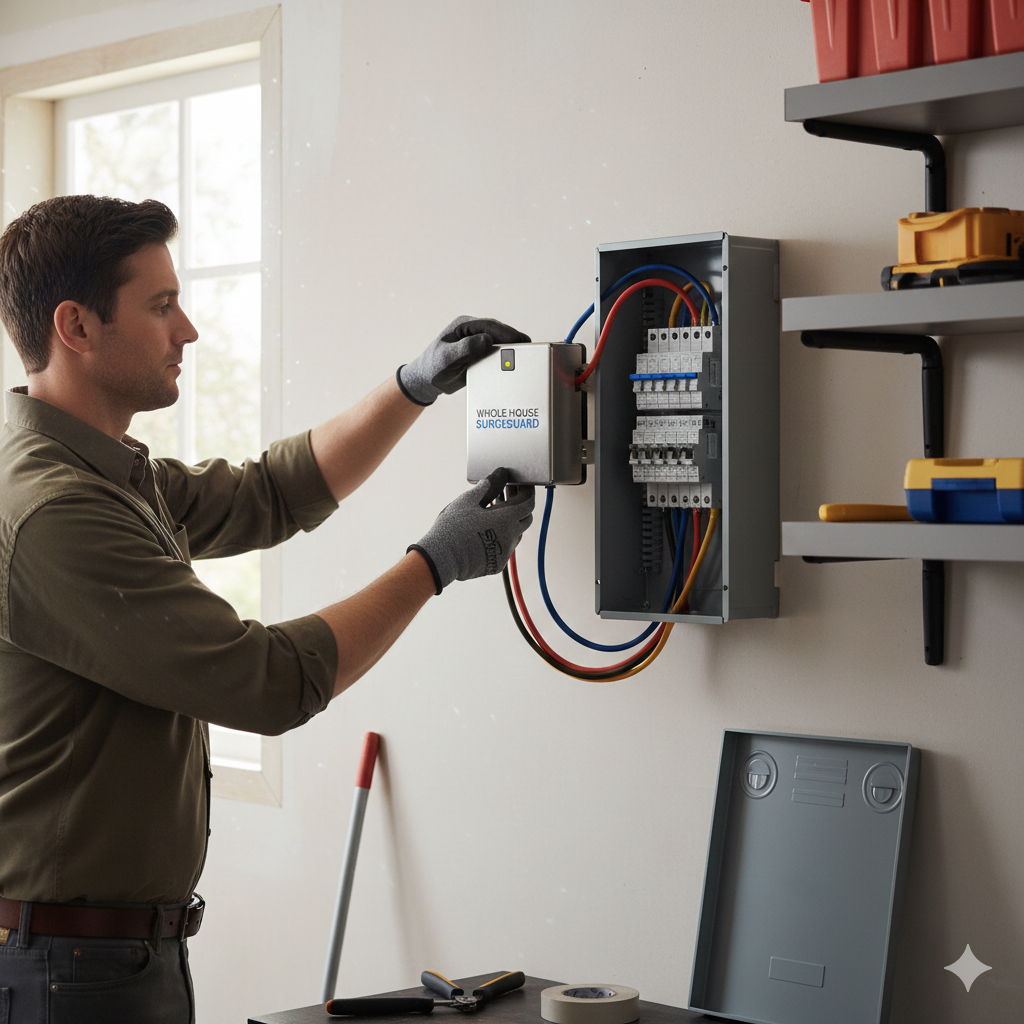
Modern homes contain thousands of dollars worth of sensitive electronic equipment, from computers and home entertainment systems to smart home devices and major appliances with electronic controls. All of this equipment faces a constant threat that most homeowners underestimate: power surges. A comprehensive whole house surge protection system provides the first and most important line of defense against these destructive electrical events.
Understanding how power surges occur, the damage they cause, and how whole house surge protection works allows you to make informed decisions about protecting your valuable electronics and appliances. This comprehensive guide explains everything you need to know about whole house surge protection, from the science behind power surges to selecting and installing the right protection system for your home.
Understanding Power Surges: The Invisible Threat
A power surge, also called a transient voltage, occurs when the voltage in your electrical system suddenly increases above its normal level. In the United States, standard household voltage is 120 volts for most circuits. A surge represents any voltage spike above this normal level, ranging from just a few volts to thousands of volts depending on the source and severity of the event.
Power surges happen far more frequently than most homeowners realize. While dramatic lightning strikes capture attention, the typical home experiences dozens or even hundreds of smaller surges throughout the year. These surges may be too small to notice immediately, but their cumulative effect gradually degrades and destroys electronic components over time.
Lightning Strikes and Direct Hits
Lightning represents the most powerful and destructive source of power surges. A direct lightning strike to your home's electrical system can deliver over 100,000 volts and millions of watts of power in a fraction of a second. This massive energy surge will instantly destroy virtually any electronic device connected to the electrical system, often starting fires and causing catastrophic damage to wiring, electrical panels, and appliances.
Even more common than direct strikes are nearby lightning strikes. When lightning hits near your home - striking a nearby tree, the ground, or utility lines in your area - the electrical charge can travel through the ground and utility lines, entering your home's electrical system as a powerful surge. While not as devastating as a direct hit, nearby strikes regularly deliver surges of 10,000 to 30,000 volts, more than enough to destroy unprotected electronics.
In areas like Northern Nevada, where thunderstorms occur regularly during certain seasons, lightning-induced surges represent a significant and recurring threat to home electronics. The high desert elevation and atmospheric conditions can produce particularly intense electrical storms, making surge protection especially important for homeowners in the Reno and Sparks areas.
Utility Company Switching and Grid Operations
Electric utility companies regularly switch power between different circuits, substations, and transmission lines to balance loads, perform maintenance, and respond to problems on the grid. These switching operations create voltage fluctuations and surges that propagate through the power distribution system to your home.
When utility companies switch large loads or bring backup generators online during outages, the sudden change in power flow can create significant voltage spikes. These surges typically range from a few hundred to several thousand volts - smaller than lightning strikes but still capable of damaging sensitive electronics.
Grid operations also include the switching of capacitor banks used for power factor correction, transformer tap changes for voltage regulation, and the connection or disconnection of large industrial loads. Each of these operations can introduce transient voltages into the distribution system. Because utility switching happens regularly and without warning, these surges represent an ongoing threat that occurs dozens of times per month in most areas.
Large Appliance Cycling
One of the most overlooked sources of power surges originates inside your own home. Large appliances and equipment that cycle on and off create power surges on your home's electrical circuits. These internally-generated surges are typically smaller than external surges from lightning or utility operations, but because they occur frequently and affect nearby equipment on the same circuit, they cause significant cumulative damage over time.
Air conditioning systems represent one of the most common sources of internal surges. When an AC compressor starts, it draws a large inrush current that can temporarily pull down voltage on the circuit. When the compressor then shuts off, the sudden stop in current flow can create a voltage spike as the magnetic fields in the motor collapse. This cycle repeats dozens of times per day during cooling season.
Similarly, refrigerators and freezers cycle their compressors on and off continuously to maintain temperature. Heat pumps, well pumps, pool pumps, and large power tools all create surges when their motors start and stop. Even less obvious devices like furnace blowers, garage door openers, and washing machines contribute to the constant background noise of small power surges in your home's electrical system.
While each individual surge from appliance cycling may be small - often just 10 to 100 volts above normal - their frequency means your electronics may experience hundreds of these small surges daily. The cumulative effect gradually degrades sensitive electronic components through a process called "data line stress," eventually leading to premature failure.
Grid Issues and Power Quality Problems
The electrical grid faces increasing strain from growing demand, aging infrastructure, and integration of renewable energy sources with variable output. These factors contribute to power quality problems that manifest as surges, sags, and transient voltages affecting homes and businesses.
Downed power lines, traffic accidents involving utility poles, animal contact with transformers, and equipment failures all create sudden changes in voltage that propagate through the grid. The increasing prevalence of solar panels and other distributed generation sources introduces additional complexity, as these systems can create voltage fluctuations when they connect to or disconnect from the grid.
Power restoration after outages represents a particularly high-risk time for surge damage. When utility crews restore power to areas affected by outages, the sudden energization of circuits can create significant voltage spikes. Many homeowners experience damage to electronics following power restoration after storms or other outage events.
How Power Surges Damage Your Electronics
Understanding the mechanisms by which surges damage electronics helps explain why comprehensive protection is so important. Surges cause two distinct types of damage: catastrophic immediate failure and gradual cumulative degradation.
Catastrophic Failure from Major Surges
Large power surges from lightning strikes or major grid events deliver voltage levels far exceeding what electronic components are designed to handle. When a surge of several thousand volts hits a device designed for 120 volts, the excess voltage overwhelms the component's insulation and creates electrical arcs between conductors that should remain isolated.
This arcing generates intense heat instantaneously, literally vaporizing microscopic traces on circuit boards, burning out semiconductor junctions in microprocessors and integrated circuits, and welding together components that should remain separate. The damage happens so quickly that protective circuits within the device have no time to respond.
Catastrophic surge damage presents obvious symptoms: devices that will not power on at all, visible burning or melting of components, blown fuses, and complete loss of function. While dramatic, these immediate failures actually represent a small percentage of total surge damage because major surges capable of causing instant destruction are relatively rare.
Gradual Degradation from Cumulative Exposure
The more insidious and common form of surge damage occurs gradually over months or years of exposure to small voltage spikes. Modern electronics contain sensitive semiconductor components - transistors, integrated circuits, microprocessors - made from materials with very specific electrical properties. These properties can be permanently altered by exposure to voltage levels even slightly above their design specifications.
Each time a small surge passes through an electronic device, it stresses the semiconductor junctions and microscopic circuit traces. This stress may not cause immediate failure, but it alters the physical structure of the components at the molecular level. Insulation breaks down slightly, junction barriers erode, and conducting traces develop microscopic cracks.
Over time, this cumulative damage degrades device performance and reliability. You might notice computers becoming unstable and crashing more frequently, smart TVs freezing or rebooting randomly, or appliances developing intermittent electronic control failures. Eventually, the accumulated damage reaches a critical point and the device fails completely.
This gradual failure mode is particularly problematic because homeowners rarely connect the device failure to power surges. When a five-year-old computer stops working or a refrigerator's electronic control board fails, the tendency is to attribute it to normal wear or bad luck rather than recognizing that preventable surge damage destroyed the device prematurely.
Research by power quality experts indicates that cumulative surge damage accounts for approximately 80% of all surge-related electronic failures. This makes protection against small, frequent surges just as important as protection against rare but dramatic lightning strikes.
Types of Surge Protection: Point-of-Use vs. Whole-House
Surge protection devices fall into two primary categories based on where they are installed and what they protect. Understanding the differences, advantages, and limitations of each type is essential for developing an effective protection strategy.
Point-of-Use Surge Protectors
Point-of-use surge protectors are the familiar power strips and outlet devices that most people associate with surge protection. These devices connect between an individual outlet and the equipment you want to protect. They contain Metal Oxide Varistors (MOVs) or similar components that divert surge energy away from connected equipment.
The primary advantage of point-of-use protectors is that they provide protection exactly where your equipment connects to power. They can also offer additional features like USB charging ports, widely-spaced outlets for large power adapters, and master/controlled outlet groups that reduce phantom power consumption.
However, point-of-use protectors have significant limitations. First, they only protect equipment actually plugged into them. Hardwired appliances like HVAC systems, water heaters with electronic controls, garage door openers, and ceiling fans receive no protection from point-of-use devices. Second, they must be individually selected and purchased for each location where you have valuable electronics. Third, and most importantly, they act as the last line of defense, attempting to handle the full energy of surges that have already entered your home's electrical system.
When a major surge enters your home, point-of-use protectors must absorb and divert potentially enormous amounts of energy. This can overwhelm their protective components, causing them to fail and leave equipment unprotected - often without any indication that protection has been lost. Many inexpensive point-of-use surge protectors provide minimal protection and fail after a single significant surge event.
Whole-House Surge Protection Systems
Whole-house surge protection devices (also called Type 1 or Type 2 surge protective devices) install at your home's main electrical panel or at the meter base. These systems protect your entire electrical system by intercepting surges before they can distribute throughout your home's wiring.
A whole-house surge protector serves as the first line of defense against external surges entering through utility lines. When a surge travels into your home from lightning, utility switching, or grid events, the whole-house protector detects the overvoltage and immediately diverts the surge energy to ground before it can reach your electrical circuits, outlets, and connected equipment.
The key advantage of whole-house protection is comprehensive coverage. A single device at the panel protects everything in your home: hardwired appliances, lighting systems, HVAC equipment, well pumps, garage door openers, and all outlets and circuits throughout the house. This includes equipment that cannot be protected by point-of-use devices.
Whole-house protectors are also designed to handle much larger surge energies than point-of-use devices. Quality whole-house units can absorb and divert the energy from nearby lightning strikes and major grid events that would instantly destroy typical point-of-use protectors. This higher capacity means whole-house systems provide more reliable protection and have longer service lives.
Understanding Surge Protection Ratings
Surge protectors are rated using several key specifications that indicate their protective capabilities. Understanding these ratings helps you select appropriate protection devices and evaluate the adequacy of existing protection.
Clamping voltage (also called let-through voltage) indicates the voltage level at which the surge protector begins to divert surge energy. Lower clamping voltages provide better protection by limiting the voltage that reaches your equipment. The UL 1449 standard defines three voltage ratings: 330V, 400V, and 500V. Premium surge protectors typically offer 330V or 400V clamping voltages.
Energy absorption capacity, measured in joules, indicates how much surge energy the device can absorb before its protective components degrade or fail. Higher joule ratings mean the protector can handle more or larger surge events before needing replacement. Quality whole-house surge protectors typically offer ratings from 50,000 to over 100,000 joules, while point-of-use devices range from 500 to 4,000 joules.
Response time indicates how quickly the surge protector reacts to voltage spikes. Modern surge protectors using MOV technology typically respond in nanoseconds (billionths of a second), fast enough to protect against even the most rapid voltage transients. Response times under 1 nanosecond are considered excellent.
Maximum surge current rating indicates the peak current the device can handle during a surge event. This is typically measured in kiloamps (kA). Whole-house surge protectors should have maximum surge current ratings of at least 50kA, with premium units offering 100kA or higher ratings for maximum protection capability.
Benefits of Whole-House Surge Protection
Installing a whole-house surge protection system provides multiple important benefits that extend beyond simply preventing equipment damage.
Comprehensive Protection for All Equipment
The most significant benefit of whole-house surge protection is universal coverage. Unlike point-of-use protectors that only protect equipment plugged into them, a whole-house system protects everything connected to your electrical system. This includes:
- Hardwired appliances: HVAC systems, water heaters, dishwashers, garbage disposals, and other equipment directly wired to circuits
- Built-in systems: Garage door openers, ceiling fans, bathroom ventilation fans, and permanently installed lighting
- Smart home devices: Thermostats, security systems, doorbell cameras, and home automation controllers
- Major systems: Well pumps, septic system controls, pool equipment, and irrigation controllers
- Outlet circuits: All standard outlets throughout your home receive baseline protection
This comprehensive coverage is particularly important for modern appliances and systems that incorporate electronic controls. A new refrigerator may cost $2,000, but the electronic control board that manages its operation might cost $400 to replace and represents a critical single point of failure. Whole-house surge protection defends these expensive, difficult-to-replace components throughout your home.
Protection for Hardwired Appliances
Many of your home's most expensive systems cannot be protected by point-of-use surge protectors because they connect directly to electrical circuits rather than plugging into outlets. HVAC systems can cost $15,000 or more to replace, and their electronic control boards, variable-speed motors, and smart thermostats are all vulnerable to surge damage.
Similarly, modern water heaters often include electronic controls for temperature management and efficiency optimization. Garage door openers use sensitive electronic circuit boards for remote operation and safety features. High-efficiency washing machines and dryers rely on sophisticated electronic controls that regulate cycle timing, water temperature, and energy consumption.
When surge damage destroys the control board in a hardwired appliance, you face expensive repair bills - often $300 to $800 for parts and labor - or premature replacement of the entire appliance. Whole-house surge protection represents the only practical way to defend these hardwired systems against power surge damage.
Peace of Mind and Convenience
Once a whole-house surge protector is professionally installed, it provides continuous protection without requiring any action or attention from you. Unlike point-of-use protectors that you must remember to use, that can be accidentally unplugged, or that children might disconnect, a whole-house system operates invisibly and automatically.
You don't need to worry about whether you've protected every valuable electronic device, whether your point-of-use protectors are still functioning, or whether guests visiting your home might plug expensive equipment into unprotected outlets. The whole-house system provides baseline protection automatically for everything in your home.
This peace of mind extends to worry-free travel. When you're away from home, you can be confident that your security systems, HVAC equipment, and other vital systems have protection from power surges caused by storms or grid events that might occur during your absence.
Lower Long-Term Costs
While whole-house surge protection requires an upfront investment, it typically costs far less than replacing even a single major appliance damaged by power surges. Consider the replacement costs of common household equipment:
- Desktop computer with monitor: $1,200 - $2,500
- High-end television and home theater system: $2,000 - $5,000
- Refrigerator with electronic controls: $1,500 - $3,500
- HVAC system control board replacement: $400 - $1,200
- Gaming console and accessories: $500 - $800
- Home office equipment (computer, printer, router, etc.): $2,000 - $4,000
- Smart home automation system: $1,000 - $5,000
A single lightning strike or major grid surge event could easily cause $10,000 or more in equipment damage throughout a home without adequate protection. Even gradual degradation from small surges over several years typically results in premature failure of multiple devices, creating ongoing replacement costs that exceed the one-time investment in whole-house protection.
How Whole-House Surge Suppressors Work
Understanding the operating principles of whole-house surge protection systems helps explain why they provide superior protection compared to point-of-use devices.
Installation at the Electrical Panel
Whole-house surge protectors install at your main electrical panel (load center), connecting to the main service conductors before they distribute to individual circuit breakers. This location allows the surge protector to intercept voltage spikes at the entry point to your home's electrical system, before surges can propagate to circuits and outlets throughout the house.
The surge protector connects in parallel with your electrical system, meaning normal current flows through your panel to circuits as usual. The surge protector continuously monitors the voltage on the main service lines but does not interfere with normal power delivery. It only acts when it detects voltage exceeding normal levels.
This parallel connection differs from how circuit breakers work. Circuit breakers are series devices that can interrupt current flow when they detect overloads or short circuits. Surge protectors operate in parallel, providing an alternative path to ground for surge energy while allowing normal current to continue flowing to your equipment.
Clamping Voltage and Diverting Surge Energy
When a voltage surge enters your home's electrical system, the whole-house surge protector detects when voltage exceeds its clamping voltage threshold. At this point, the protector's internal components rapidly switch from high impedance (electrically invisible) to low impedance (highly conductive), creating a low-resistance path to ground.
This sudden provision of an easy path to ground causes the surge current to flow through the surge protector rather than continuing into your home's circuits and equipment. The protector essentially short-circuits the surge to ground, diverting the excess energy away from your sensitive electronics.
Modern whole-house surge protectors use Metal Oxide Varistors (MOVs) as their primary active components. MOVs are semiconductor devices that change their resistance based on the voltage across them. At normal voltages, MOVs have very high resistance (millions of ohms), so they draw virtually no current and do not interfere with normal operation. When voltage exceeds the MOV's threshold, its resistance drops dramatically to just a few ohms, allowing thousands of amps of surge current to pass through it to ground.
This voltage-dependent resistance change happens extremely rapidly - in less than a nanosecond - allowing the surge protector to respond faster than the surge can damage your equipment. Once the voltage returns to normal levels, the MOV immediately returns to its high-resistance state and becomes electrically invisible again.
Grounding and Dissipating Excess Energy
For surge protection to work effectively, the diverted surge energy must have somewhere to go. This is where proper grounding becomes critical. The whole-house surge protector connects to your home's grounding system - typically the ground bus bar in your electrical panel, which connects to ground rods driven into the earth and to the metal water supply system (if applicable).
When the surge protector diverts surge energy, that energy flows through the grounding system and dissipates into the earth. The earth has virtually unlimited capacity to absorb electrical charge, making it the ideal destination for unwanted surge energy.
The effectiveness of surge protection depends heavily on the quality of your grounding system. Inadequate grounding - corroded ground connections, undersized ground conductors, or high-resistance ground rods - limits the surge protector's ability to quickly divert surge energy. This is why professional installation by a licensed electrician is essential; they can evaluate and improve grounding as necessary to ensure optimal surge protection performance.
In areas with dry soil or rocky terrain like Northern Nevada, achieving good electrical grounding can be challenging. Professional electricians may need to install multiple ground rods, use chemical ground enhancement materials, or employ other techniques to achieve the low ground resistance necessary for effective surge protection.
What to Look for in a Whole-House Surge Protector
Selecting the right whole-house surge protection system requires evaluating several critical specifications and features.
UL 1449 Listing and Certification
Always choose surge protectors that carry UL 1449 listing. This certification from Underwriters Laboratories indicates the device has been tested to meet rigorous safety and performance standards. UL 1449 is the recognized safety standard for Surge Protective Devices (SPDs) in North America.
The UL 1449 standard defines testing protocols for surge capacity, temperature rise, abnormal operation, and endurance. Devices that pass UL 1449 testing have demonstrated they can safely handle rated surge currents without creating fire hazards or safety risks. Non-UL listed surge protectors may make performance claims that have not been independently verified and could pose safety risks.
UL 1449 also categorizes surge protectors by their voltage protection rating (VPR): 330V, 400V, 500V, 600V, or higher. Look for whole-house surge protectors with VPR ratings of 400V or lower for optimal equipment protection.
Appropriate Clamping Voltage
The clamping voltage determines how much voltage the surge protector allows to reach your equipment. Lower clamping voltages provide better protection by limiting the voltage stress on sensitive electronics. For whole-house surge protectors in residential applications, look for clamping voltages between 330V and 400V.
Be aware that some manufacturers advertise "let-through voltage" or "suppressed voltage rating" instead of clamping voltage, but these terms refer to the same specification. The voltage rating should be measured across all modes: line-to-neutral, line-to-ground, and neutral-to-ground protection.
Adequate Joule Rating
The joule rating indicates the total surge energy the protector can absorb over its lifetime before its protective components degrade. For whole-house applications, look for minimum ratings of 50,000 joules, with premium units offering 80,000 to 120,000 joules or higher.
Higher joule ratings mean the surge protector will provide reliable protection for more years and can handle more surge events before needing replacement. In areas with frequent lightning activity or poor power quality, higher joule ratings are particularly important for long-term protection.
High Maximum Surge Current Rating
The maximum surge current rating (measured in kiloamps, or kA) indicates the peak current the surge protector can safely handle during a single surge event. For whole-house surge protectors, minimum ratings should be 50kA per mode, with premium units offering 100kA or even 140kA ratings.
Higher surge current ratings provide better protection against nearby lightning strikes and major grid surges. Units with higher ratings also tend to have more robust internal components that provide longer service life and more reliable protection.
Comprehensive Warranty Protection
Reputable surge protector manufacturers stand behind their products with substantial warranties. Look for surge protectors that offer:
- Long product warranties: Premium whole-house surge protectors typically offer lifetime or 10+ year product warranties
- Connected equipment warranties: Many manufacturers provide insurance-backed warranties that cover equipment damage if the surge protector fails to provide adequate protection, often ranging from $50,000 to $150,000 in coverage
- Clear warranty terms: Understand what is covered, how claims are filed, and any requirements (such as professional installation or proper grounding) necessary for warranty validity
While you should never rely solely on warranty coverage for protection, strong warranties indicate manufacturer confidence in their product's protective capabilities and provide valuable backup protection for your investment.
Diagnostic and Monitoring Features
Quality whole-house surge protectors include visual indicators or monitoring systems that confirm the unit is functioning properly and alert you when protection has been compromised. Look for features such as:
- Status indicator lights: LEDs that confirm the unit is properly connected and providing protection
- Failure alarms: Audible or visual alarms that activate if the surge protector's components have degraded and it can no longer provide adequate protection
- Remote monitoring: Some advanced units offer connectivity to home automation systems or smartphone apps that provide real-time status monitoring and alert you to protection issues
- Surge counter: Some units track the number of surge events, helping you understand your environment's power quality and anticipate when replacement might be necessary
These diagnostic features are valuable because surge protector components degrade gradually over time and with each surge event they handle. Without monitoring capabilities, you might not know that your surge protector has lost its protective capability until equipment damage occurs.
Professional Installation Requirements
Whole-house surge protection must be installed by a licensed electrician for several important reasons related to safety, performance, and code compliance.
Why Professional Installation Is Essential
Installing a whole-house surge protector requires working inside your home's main electrical panel while it is energized. The main service conductors entering your panel carry the full current capacity of your electrical service - typically 100 to 200 amps or more - and are not protected by any circuit breaker or fuse. Contact with these conductors can result in severe electrical shock, arc flash burns, or electrocution.
Only licensed electricians have the training, experience, and specialized tools necessary to safely work on energized electrical panels. Attempting DIY installation of a whole-house surge protector puts you at serious risk of injury or death and is illegal in most jurisdictions for work on service entrance equipment.
Beyond safety concerns, professional installation ensures the surge protector is correctly sized for your electrical service, properly connected to the panel's grounding system, and installed in compliance with the National Electrical Code (NEC) and local amendments. Improper installation can render the surge protector ineffective or even create new electrical hazards.
Optimal Location at the Service Panel
The electrician will install the whole-house surge protector at your main electrical panel, connecting it to the service entrance conductors before the main disconnect breaker (Type 1 SPD) or to the load side of the main disconnect (Type 2 SPD). The specific installation location depends on your panel configuration, available space, and the type of surge protector being installed.
Type 1 surge protectors install on the line side (utility side) of the main service disconnect, providing the earliest possible interception of incoming surges. Type 2 surge protectors install on the load side of the main disconnect and are more common in residential applications. Both types provide excellent protection when properly installed.
The electrician will ensure all connections are properly torqued to manufacturer specifications, as both loose connections and over-tightened connections can cause problems. They will verify that the surge protector's leads are routed to minimize inductance (electrical resistance to changing current), which optimizes the protector's response speed.
Grounding System Evaluation and Improvement
Perhaps the most critical aspect of professional installation is evaluation and optimization of your home's grounding system. A surge protector can only be as effective as the grounding system it connects to. If your grounding system has high resistance or poor connections, surge energy cannot be efficiently diverted to earth, reducing protection effectiveness.
The electrician will test your grounding system to measure its resistance to earth. The NEC requires ground resistance of 25 ohms or less, but for optimal surge protection, resistance of 5 ohms or less is ideal. In areas with dry or rocky soil, achieving low ground resistance may require installing multiple ground rods, using longer ground rods, treating ground rods with conductive enhancement materials, or employing other specialized grounding techniques.
The electrician will also inspect all ground connections for corrosion or damage, verify proper bonding between grounding electrodes and the electrical system, and ensure that supplemental grounding electrodes (metal water pipes, building steel, concrete-encased electrodes) are properly connected if present.
Code Compliance and Permitting
Installation of whole-house surge protection typically requires an electrical permit and inspection by local building authorities. Licensed electrical contractors handle all permitting requirements and coordinate required inspections to ensure the installation meets code.
The National Electrical Code (NEC) Article 230.67 requires surge protection on all dwelling units with service equipment rated 1000 amps or greater. While most residential services are 200 amps or less and therefore not mandated to have surge protection under this NEC provision, many local jurisdictions have adopted amendments requiring surge protection on all new construction or service upgrades.
Professional installation with proper permitting and inspection ensures your surge protection system meets all applicable codes and regulations. This documentation can be important for insurance purposes, home sales, and verification of work quality.
The Layered Protection Approach
While whole-house surge protection provides excellent baseline protection for your entire electrical system, the most comprehensive protection strategy combines whole-house and point-of-use surge protection in a layered defense approach.
Why Layering Provides Superior Protection
Even the best whole-house surge protector cannot eliminate 100% of surge energy. Very fast transient surges or surges generated within your home from appliance cycling may not be completely stopped by the whole-house unit. Additionally, surges can enter your home through paths other than the electrical service lines, such as cable TV connections, telephone lines, or network data cables.
A layered protection strategy uses the whole-house surge protector to handle the bulk of incoming surge energy, dramatically reducing the size of any surge that reaches your home's circuits. Point-of-use surge protectors at critical equipment locations then provide secondary protection, dealing with any residual surge energy that made it past the whole-house unit and protecting against surges entering through data and communication lines.
This two-stage approach is analogous to how your home's security might use both a locked perimeter fence and locked doors. Each layer of protection handles what gets through the previous layer, providing redundancy and significantly increasing overall security - or in this case, surge protection effectiveness.
Whole-House Protection as the Foundation
The whole-house surge protector serves as your primary defense, intercepting large external surges at the service entrance before they can enter your home's wiring. By clamping major surge events at the panel, the whole-house unit prevents these powerful surges from reaching circuits throughout your home.
This primary protection is especially important for hardwired equipment that cannot use point-of-use protectors. Your HVAC system, garage door opener, ceiling fans, and hardwired appliances rely entirely on the whole-house surge protector for protection.
The whole-house unit also protects your home's wiring itself from surge damage. Repeated exposure to large surges can degrade wiring insulation and damage connections throughout your electrical system. By limiting surges at the service entrance, the whole-house protector extends the life of your entire electrical system.
Point-of-Use Protection for Sensitive Equipment
After installing whole-house surge protection, add quality point-of-use surge protectors at locations with particularly sensitive or valuable electronics:
- Home office equipment: Computers, monitors, printers, routers, and network equipment
- Home entertainment systems: Televisions, gaming consoles, audio receivers, and streaming devices
- Smart home hubs: Home automation controllers and security system panels
- Workshop and garage: Computers, battery chargers, and sensitive power tools
When selecting point-of-use surge protectors for a layered protection system, look for quality units with adequate joule ratings (minimum 1,000 joules, preferably 2,000+), low clamping voltages (400V or less), and protection for data lines (coaxial, Ethernet, phone) that might carry surges into equipment.
Point-of-use protectors in a layered system don't need to handle massive surge energies because the whole-house unit has already dealt with the bulk of incoming surges. This means your point-of-use protectors will last longer and provide more reliable protection when used in conjunction with whole-house protection than they would when used alone.
Protecting Data and Communication Lines
Surge protection must extend beyond just electrical power lines to include data and communication connections. Cable TV coaxial lines, telephone lines, internet connections, and satellite dish cables can all carry surge energy into your home. A lightning strike to an exterior antenna or nearby utility lines can send thousands of volts through these connections, damaging connected equipment even if your electrical circuits are protected.
Quality point-of-use surge protectors include protection for coaxial, telephone, and Ethernet connections in addition to AC power outlets. For complete protection of home entertainment and computer systems, these data line connections should pass through the surge protector along with the power connections.
Some whole-house surge protection systems also include modules for protecting telephone and cable TV service entrance lines at the point where they enter your home. This provides primary protection for these pathways, complementing the secondary data line protection at point-of-use surge protectors.
Cost Versus Value: A Smart Investment
Understanding the financial aspects of surge protection helps put the investment in proper perspective.
Installation Investment
Professional installation of a whole-house surge protector typically costs between $300 and $800, depending on the unit selected, your electrical panel configuration, and whether any improvements to your grounding system are necessary. This investment includes the surge protector device itself (usually $150-$400 for quality residential units) plus professional installation labor and any required permits.
While this represents a meaningful upfront cost, it's important to compare it to the equipment it protects and the potential costs of surge damage.
Equipment Replacement Costs
Consider the total value of electronics and appliances in your home that would be affected by a major surge event:
- Computers, laptops, and tablets: $2,000 - $5,000
- Televisions and entertainment systems: $2,500 - $6,000
- Kitchen appliances with electronic controls: $5,000 - $12,000
- HVAC system components: $500 - $2,000 (control boards and sensors)
- Smart home devices and security systems: $1,000 - $4,000
- Home office equipment: $2,000 - $5,000
- Other electronic devices: $1,000 - $3,000
Most homes contain $15,000 to $40,000 or more in vulnerable electronics and appliances. A single major surge event could easily damage $10,000 worth of equipment. Even without a catastrophic event, cumulative degradation from small surges over several years typically results in premature failure of multiple devices.
Insurance Considerations
While homeowner's insurance policies typically cover some surge damage, particularly from lightning strikes, coverage usually requires paying your deductible (often $500-$2,500) and may not cover full replacement costs for electronics that have depreciated in value. Some policies exclude certain types of surge damage or have sub-limits on electronics coverage.
Additionally, filing insurance claims for surge damage can potentially affect your premiums and claim history. Preventing the damage in the first place through surge protection avoids the hassle of insurance claims, eliminates out-of-pocket costs for deductibles, and protects your insurance history.
Some insurance companies offer discounts on homeowner's insurance premiums for homes with whole-house surge protection. Even a modest annual premium reduction of $25-$50 can offset a significant portion of the surge protector investment over its service life.
Long-Term Value
Quality whole-house surge protectors typically provide effective protection for 5 to 10+ years, depending on the severity and frequency of surge events they handle. Over this lifespan, a $500 investment in surge protection costs roughly $4-8 per month - less than a single coffee at a café.
This minimal ongoing cost protects equipment worth tens of thousands of dollars and prevents the inconvenience, data loss, and disruption that comes with surge-damaged electronics. The peace of mind alone is worth the investment for most homeowners, especially in areas prone to thunderstorms or with unreliable power quality.
Maintenance and Replacement Indicators
While whole-house surge protectors require minimal ongoing maintenance, monitoring their status and understanding when replacement is necessary ensures continuous protection.
Regular Status Monitoring
Most whole-house surge protectors include LED status indicators that confirm the unit is functioning properly. Make it a habit to visually check these indicators monthly. A green or lit indicator typically means the unit is providing protection, while a red, dark, or flashing indicator may signal that the unit has degraded and requires replacement.
Some advanced surge protectors include audible alarms that sound when protection capability has been compromised. Never ignore these alarms - they indicate your surge protection is no longer functioning and should be replaced promptly to restore protection.
After Major Surge Events
After any significant surge event - particularly nearby lightning strikes, direct lightning hits, or major grid disturbances that affect your area - verify that your surge protector's status indicators still show proper function. Even if the surge protector successfully diverted the surge and prevented equipment damage, the event may have degraded its protective components.
Following severe surge events, consider having a licensed electrician test the surge protector to verify it still provides adequate protection. This small investment in verification can prevent the much larger cost of operating without protection while assuming you're still protected.
Understanding Component Degradation
Surge protector components, particularly MOVs, degrade gradually each time they divert surge energy. This degradation is cumulative and irreversible. Eventually, after handling many surges or one extremely large surge, the protective components can no longer clamp voltage effectively. At this point, the surge protector must be replaced.
The degradation is usually not linear - a surge protector may operate effectively for years, then degrade more rapidly as its components approach end of life. This is why monitoring status indicators and testing after major events is so important.
Typical Service Life and Replacement Timing
In typical residential applications with average power quality and occasional surge events, quality whole-house surge protectors generally provide effective protection for 5 to 10 years or longer. However, service life varies significantly based on:
- Frequency and severity of surge events in your area
- Quality and capacity of the surge protector
- Adequacy of your grounding system
- Overall power quality from your utility
In areas with frequent lightning strikes or poor power quality, surge protectors may require replacement more often. Conversely, in areas with excellent power quality and few surge events, surge protectors may provide protection for 15+ years.
Many manufacturers recommend replacement after any direct lightning strike to your electrical system, even if status indicators still show the unit functioning. Direct strikes can stress components in ways that may not immediately show on diagnostic indicators but that compromise future protective capability.
Professional Inspection and Testing
Consider including surge protector inspection as part of any comprehensive electrical system evaluation or when scheduling other electrical work. Licensed electricians can test surge protector function, verify proper status indicators, check all connections for tightness and corrosion, and assess whether replacement is warranted.
This professional verification is particularly valuable for homes that have experienced significant weather events, power outages, or electrical disturbances, or for surge protectors approaching 7-10 years of age.
Protecting Your Northern Nevada Home
In the Reno, Sparks, and greater Northern Nevada area, whole-house surge protection is especially valuable due to the region's unique electrical environment. The high desert location experiences frequent summer thunderstorms with intense lightning activity. The region's rapid growth places increasing demands on electrical infrastructure, sometimes leading to power quality issues as the grid expands to serve new development.
Additionally, the rocky, dry soil conditions common in Northern Nevada can make establishing good electrical grounding more challenging than in other regions. Professional electricians familiar with local conditions understand the specialized grounding techniques necessary to achieve the low ground resistance essential for effective surge protection in this environment.
Hay & Wilson Electric brings extensive experience installing whole-house surge protection systems throughout the Reno-Sparks area. We understand local soil conditions, code requirements, and the specific power quality challenges facing Northern Nevada homeowners. Our team evaluates your existing electrical system and grounding, recommends appropriately-sized surge protection for your needs, and ensures professional installation that provides reliable, long-lasting protection.
Take Action to Protect Your Investment
Whole-house surge protection represents one of the most cost-effective investments you can make to protect your home's valuable electronics, appliances, and electrical systems. Power surges from lightning, utility operations, and appliance cycling occur regularly and cause billions of dollars in equipment damage annually. This damage is almost entirely preventable through proper surge protection.
A professionally-installed whole-house surge protector provides comprehensive protection for everything in your home, from expensive HVAC systems to computers and entertainment equipment. The relatively modest investment in surge protection costs far less than replacing even a single major appliance damaged by power surges, while providing peace of mind and continuous protection for years.
The most effective protection strategy combines whole-house surge protection with quality point-of-use protectors at locations with particularly sensitive equipment. This layered approach provides redundant protection and safeguards against surges entering through both power lines and data connections.
Don't wait until after a surge damages your equipment to implement protection. Contact Hay & Wilson Electric today to discuss whole-house surge protection options for your Northern Nevada home. Our licensed electricians will evaluate your electrical system, recommend appropriate surge protection solutions, and provide professional installation that ensures reliable protection for your valuable electronics and appliances.